AI Football Analysis vs. Human Profiling: A Blind Test Experiment
In the modern betting landscape, AI football analysis is becoming the topic everyone wants to discuss. But for most bettors, the big question remains: Can a machine actually analyze a match better than a human using proven strategies?
Confirmation bias is the silent bankroll killer. We find a selection that fits our criteria, and suddenly, every statistic we look at seems to confirm our genius. We stop looking for red flags and start looking for validation.
But what if you could summon a second analyst? One who is tireless, objective, and completely unaware of your previous work?
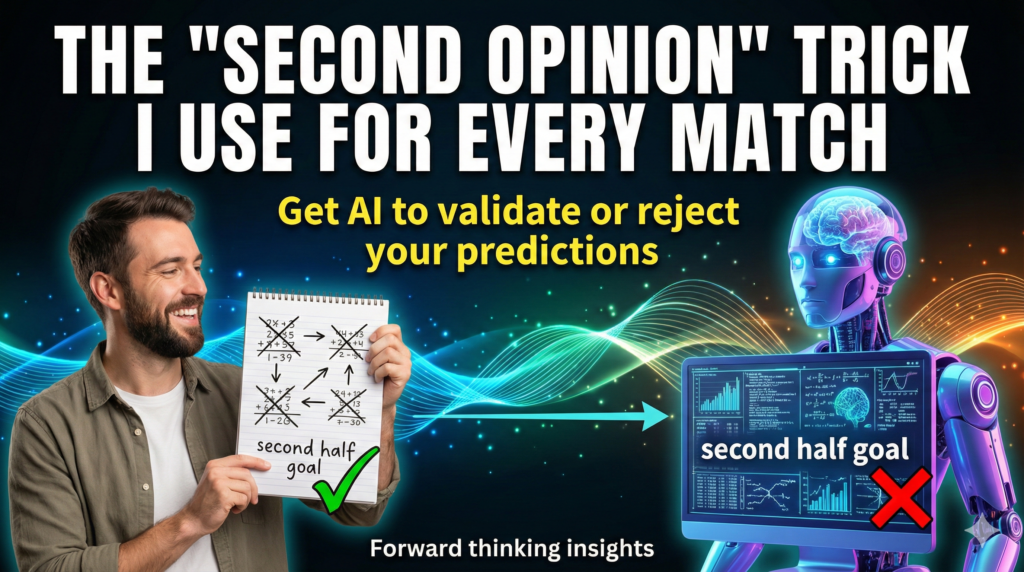
In a recent experiment documented on my YouTube channel, I explored this exact concept. I took a classic Premier League fixture—Liverpool vs. Burnley—and pitted my own “Second Half Goal” profiling strategy against a “blind” AI analysis.
This article explores the methodology behind that experiment and why integrating an AI “audit” stage into your workflow might be the biggest edge you find this year.
The Control: The Human Analyst & The “Second Half Goal” Strategy
To conduct a fair test, we first need a strong control subject. For this, I used my standard, data-heavy workflow.
My strategy focuses on identifying value in the Second Half Goal markets. This is a niche that relies heavily on patience and statistical probability. Using CGMBet, I filtered the English Premier League fixtures to find matches where the data suggested a high chance of a second half goal.
Only one selection met the criteria for the previous weekend : Liverpool vs. Burnley.
The Profiling Tools
Once the selection is made, the real work begins. My manual profiling involves two specific statistical heavyweights:
- Advanced Poisson Distribution: Poisson is the bread and butter of predictive modeling. It allows us to calculate the probability of specific scorelines based on Liverpool’s attack strength at Anfield versus Burnley’s defensive resilience on the road. It strips away the narrative and leaves us with raw probability.
- Correct Score Analysis: By looking at historical clusters of scores between similar teams, we can build a “profile” of the game. Is this a 1-0 grind or a 4-1 thrashing?
Based on these metrics, I built a comprehensive profile for the match. I knew what the maths said should happen. But maths doesn’t watch the games.
The Variable: The “Blind” AI Audit
Here is where the methodology shifts. Most people use AI incorrectly in sports analysis. They feed the AI their stats and ask, “Do you agree?” This is useless. Large Language Models (LLMs) are designed to be helpful; if you lead the witness, they will agree with you.
To get a true second opinion, you must run a Blind Audit.
I tasked Gemini AI with analyzing the upcoming Liverpool vs. Burnley game, but I imposed strict constraints:
- No Access to My Data: The AI was not shown my Poisson calculations or CGMBet data.
- No “Second Half” Bias: I did not tell the AI that I was looking for second-half goals.
- Complex Predictive Tasks: I asked the AI to simulate the game flow, predicting not just the result, but the narrative arc of the 90 minutes.
This forced the AI to generate an opinion from scratch, using its own training data regarding team styles, managerial tactics, and player form, completely independent of my statistical model.
The Clash: Statistical Probability vs. Narrative Prediction
The beauty of this experiment lies in the divergence.
My human profiling (via CGMBet) viewed the game as a mathematical equation. It saw two vectors intersecting—one ascending (Liverpool’s attack) and one descending (Burnley’s defence)—and predicted the likely output (goals).
The AI profiling, however, viewed the game as a tactical story. It looked at the “personality” of the teams. It didn’t just calculate if a goal would be scored; it tried to predict how the game would feel. Would Burnley park the bus? Would Liverpool become frustrated?
The Results (Post-Game Analysis)
Without giving away the ending of the video, the post-match analysis revealed something fascinating about the limitations of both methods.
There were moments where the Poisson distribution was razor-sharp, predicting the volume of chances with a high degree of accuracy. The “Second Half Goal” strategy is built on this data for a reason—it works over the long term because the numbers generally stack up.
However, the AI managed to capture nuances that the data was unable to. It identified potential “game states”—psychological shifts in the match—that the raw numbers couldn’t see.
Why You Need a “Second Opinion” Workflow
So, why go through the trouble of asking AI?
The goal isn’t to replace your analysis. The goal is to catch your blind spots.
If your Poisson data says “Over 2.5 Goals” and the AI independently predicts a “High-Scoring Affair,” you have Confluence. You can increase your stake size with confidence.
But if your data says “Over 2.5 Goals” and the AI predicts a “0-0 Tactical Stalemate,” you have Divergence. This is the most valuable moment in profiling. It forces you to stop and ask: What does the AI see that I don’t? Is there an injury? A tactical mismatch? A weather condition?
That pause saves you money.
Conclusion: The Hybrid Analyst
The future of sports profiling isn’t about choosing between “Old School Data” and “New School AI.” It is about synthesis.
By combining the rigid, proven mathematical models of tools like CGMBet with the broad, narrative-based intelligence of AI, you create a hybrid profiling system that is far more robust than either method alone.
The AI didn’t get to see my history, but after this experiment, it has certainly earned a place in my future workflow.